
I don't do book reviews often. Unless you count children's literature, I don't read enough books to do regular book reviews (though I hope to change that this year...I hope!). But I just finished a book in a few days, and it's worth reviewing--even if only for my own future reference and encouragement.
So here goes...
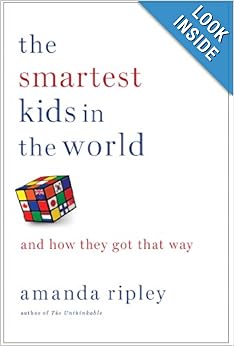
The Smartest Kids in the World and How They Got That Way is written by Amanda Ripley, a journalist who has written for TIME as well as The Atlantic. Ms. Ripley's book reveals her findings after investigating the education systems of three countries in which fifteen year old students performed well on the PISA test, an international test of higher thinking skills.
The author followed three exchange students who left the United States for a year to study abroad in these three countries--Finland, South Korea, and Poland. Her intent was to gain insight into how and why these countries' students performed so well on the PISA compared to students in the US.
She discovered that while the school systems in these countries were different, they also had commonalities that strengthened their students' performance. South Korea, for instance, could be compared to a pressure cooker. High school students typically spent 12 or so hours at school each day and then headed off for several more hours of teaching or study at one of the local, privately-owned hogwans (tutoring schools). Curfews are in place to make certain that the students go home by 10pm; however, students often continue to study into the night after returning home. The pressure on the students to do well on their high school examination and gain entrance into one of the top three universities is immense. Education is taken very seriously in South Korea, and the government literally shuts down streets and even air traffic that might distract students from the task before them on the date of the examination.
In contrast, Finnish students perform exceedingly well on the PISA test, but they have much shorter, more normal school hours. Essentially, they have a life outside of school. But they do take their education very seriously. The students understand that their success in school largely determines the trajectory of their lives insofar as their career and money-making opportunities go. They understand that school is difficult, but it is worth doing. The hard work will pay off. One distinct advantage that the Finnish students have is their highly trained teachers. In Finland, to become a teacher one must be accepted by one of the eight or so teacher training universities. A far cry from the teacher colleges of the US, these universities only accept 20% of the applicants and hold to extraordinarily high standards--on the order of MIT, if you care to compare. The teacher training program lasts a full six years with one year devoted entirely to student teaching under several well-trained mentor teachers. The course also includes three years of intense study in Finnish literature and other required academic classes. For graduation, an original thesis with research conducted by the teacher-in-training is required. Well-educated teachers seem to make the difference in Finland.
Poland is a different story. The PISA test was first given in Poland in 2000 before the educational reforms there began. As expected, Polish students performed poorly compared to the developed world. The country was still emerging from the years of economic recovery which followed the fall of communism in the Soviet Union and eastern Europe. The economy was one of the fastest growing in the world due to the intense deregulation, but the education system left Poland's young people without the necessary skills for the modern workplace. However, due to the reforms enacted by the new minister of education (an alchemist new to the political scene), just three years later Polish students' scores had exceeded those of students in the United States. The changes to Poland's education system included a newly defined level of rigor in the curriculum that would be required as well as standardized testing to target schools and students that needed extra assistance. Also, separating the students into academic versus vocational tracks one year later gave all students an additional year of academic teaching. Lastly, local autonomy was inserted into the system allowing teachers to choose their own textbooks from many approved options and bonuses were tied to professional development.
Ms. Ripley mentioned several patterns in parenting that she deemed worthy of attention due to the effect on students' test scores. The PISA test was administered with a parents' survey in order to learn more about the students' home environment, and the results were then compiled.
One result was particularly surprising. Researchers found that "parents who volunteered in their kids' extracurricular activities had children who performed worse in reading, on average, than parents who did not volunteer, even after controlling for other factors like socioeconomic background." (p. 107) The explanations offered for this unexpected result included the possibility that parents of struggling students became involved due to their child's academic difficulties in hopes of encouraging their child as well as the idea that parents were putting their energies into less important activities like sports or school fundraisers when the students would have been better served by the parents' efforts toward helping their kids learn.
A second result was less surprising. Kids whose parents had read to them every day or nearly every day when they were young performed significantly better on the reading portion of the test. How simple is that? Read to your kids! Open up the world to them through a book.
The third result was closely related to the second, but a bit deeper. Parental involvement in the kids' lives had a direct impact on their kids' reading scores on the PISA. By engaging their older children in conversations about current happenings or books or movies, parents teach their children how to think about the world, how to become mature thinking adults.
Ripley leaves the story open-ended as it has yet to be written. Will Poland's students continue to rise among the top-performers in the world? Will the United States keep on the level track that it has followed for a number of years? Will the Koreans burn out in their intensity? Will the rest of the world follow Finland's example and begin to reduce the number of individuals who are trained to be teachers while increasing the rigor in the training that teachers receive? Who can tell?
We can, however, look at the findings of her research and see ways that we can help our children improve their academic foundation. For me personally this was a great reminder of why we read to our kids often. For the last five years of homeschooling, we focused more on teaching the kids to read and do math than on reading to them. Reading aloud was always included in the plan, but it was usually the first thing to go when life got in the way. This year I've changed things up a bit (after reading The Read-Aloud Handbook by Jim Trelease over the summer). Reading gets done first now. We do our Bible, and then immediately we settle in for 30-45 minutes of reading each morning. We've enjoyed a number of great books already this year, and often there are pleadings to read "just one more chapter!" Not only are the kids listening to great stories, but we're sharing great stories. These stories have become part of our family's culture. This one change has brought great enjoyment to our homeschool this year and much satisfaction to my mind.
I appreciated Ripley's findings regarding the parental involvement as well. It's been a year since last Christmas when Grandma visited, but while she was here, she began a habit that we've continued long since. The children were holding three different conversations at the table one evening while we ate, and she wisely suggested that we select a topic for the dinner conversation. We did, though I can't recall what it was that night. But it stuck. We often have "a topic" over dinner, and that's the only conversation going. Usually at least one of the kids will ask, "So, Dad, what's the topic?" and Dad is on the spot to choose something, though sometimes it just evolves from the conversations that have already begun or the events of the day. Topics have included everything from outer space to Bible stories to knights to weather...and much more. I admit that I am not as skilled at "running" the topic when Stephen isn't here and I'm trying to make sure everyone is eating (rather than smearing their dinner all over creation), but when he's home, we will likely have a topic of discussion. He's also much better than I am at drawing out the kids' opinions and understandings on different issues. He's very good at playing devil's advocate and encouraging them to think carefully about their ideas and opinions, even the younger ones.
So for me it was reassuring to learn that some of the habits that we've fallen into or chosen have academic value as well as social and spiritual value. We'll continue our reading aloud, and we'll keep on discussing the big and small issues and events of life.
And we'll keep on plugging away at the math and reading, too.

No comments:
Post a Comment